
Protect What Matters. Plan for Tomorrow. Leave a Legacy That Reflects Your Wishes.
Life is unpredictable. Your family's future shouldn't be left entirely to chance.
You've worked hard to build a life, care for your family, and acquire the things that matter to you. But what happens to your property, your loved ones, and your financial affairs if something unexpected happens?
A thoughtfully prepared estate plan can help ensure your wishes are known, your family is protected, and the people you trust have the legal authority they need when it matters most.
At The Law Office of Lori Laird, PLLC, we assist individuals and families throughout Houston, Pasadena, Galveston, and surrounding Texas communities with wills, trusts, powers of attorney, medical directives, and other essential estate planning documents.
Whether you're preparing your first will, protecting young children, planning for retirement, or updating an estate plan after a major life change, we can help you make informed decisions about your future.
Estate planning isn't about how much you own. It's about protecting what matters to you.
Why Every Adult Needs an Estate Plan
One of the most common estate planning mistakes is assuming you don't need a will because you're young, healthy, or don't have substantial assets.
But estate planning isn't just about dividing property after death. It's also about making important decisions before a crisis occurs.
Without appropriate legal documents, your family may face unnecessary uncertainty, expenses, disagreements, or court proceedings at an already difficult time.
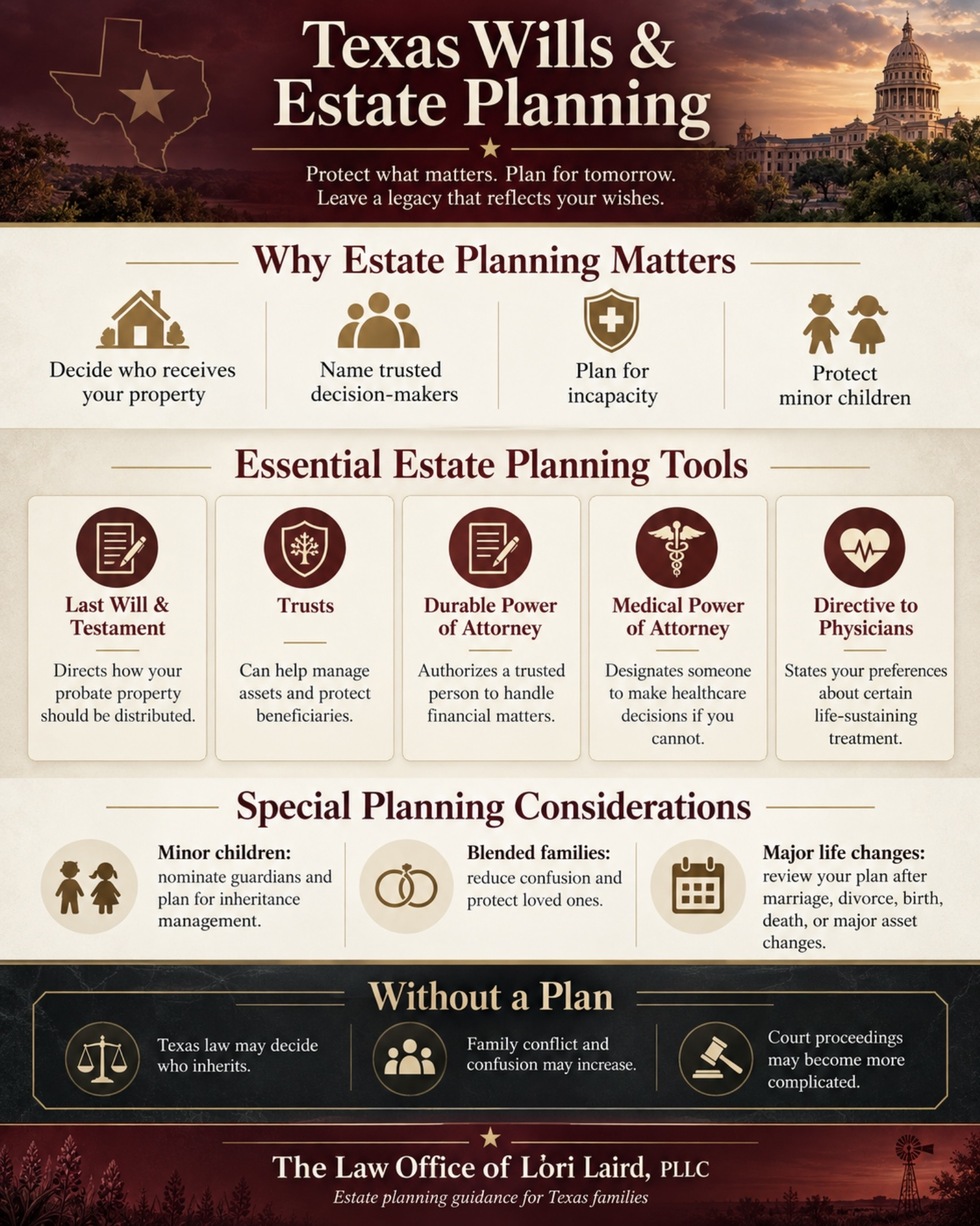
An estate plan can help you:
- Decide who inherits your property. Rather than relying entirely on Texas intestacy laws, you can express how you want your assets distributed.
- Choose someone you trust. Name an executor to administer your estate and designate agents to act on your behalf under appropriate circumstances.
- Protect your minor children. Make guardian nominations and establish plans for managing assets left to children.
- Prepare for incapacity. Authorize trusted individuals to handle financial or medical matters if you become unable to make decisions yourself.
- Reduce confusion and family conflict. Clear, properly drafted documents can provide direction when your loved ones need it most.
- Preserve your legacy. Make thoughtful decisions about the people and causes you wish to benefit.
No estate plan can prevent every potential complication. However, careful planning today may spare your family significant difficulties tomorrow.
Last Wills and Testaments: Put Your Wishes in Writing
A Last Will and Testament is one of the most important documents in an estate plan.
A properly executed Texas will allows you to provide instructions concerning the distribution of property governed by your will and designate an executor to administer your estate.
Your will may address important matters such as:
- Who should inherit your probate property
- How your property should be divided among beneficiaries
- Who should serve as executor of your estate
- Whether an independent administration is authorized
- How property intended for minor children should be managed
- Who you would prefer to serve as guardian for your children if a guardian becomes necessary
Without a valid will, Texas intestacy laws generally determine who inherits your probate estate. Those laws may produce results very different from what you intended, especially in blended families or second marriages.
And contrary to popular belief, a surviving spouse does not necessarily inherit everything when a married person dies without a will in Texas.
A carefully drafted will gives you greater control over your estate and helps provide direction for those left behind.
Trusts: More Than Just an Estate Planning Tool for the Wealthy
Trusts can provide additional flexibility for individuals and families with particular estate planning needs.
A trust is a legal arrangement in which a trustee holds or manages property for designated beneficiaries under the terms of the trust.
Depending on your circumstances, a trust may be useful for:
- Managing inheritance for minor children
- Providing for beneficiaries with special needs
- Controlling when and how beneficiaries receive property
- Protecting beneficiaries who may not be prepared to manage substantial assets
- Providing continued asset management after incapacity or death
- Addressing particular family or financial circumstances
Trusts are not automatically necessary or appropriate for everyone. They also involve legal requirements, administrative responsibilities, and potential costs.
Our firm can help evaluate whether a trust should be part of your estate planning strategy.
Powers of Attorney: Preparing for the Unexpected
What would happen if an accident, serious illness, or unexpected medical condition left you temporarily or permanently unable to manage your affairs?
Who could pay your bills, access your financial accounts, make important financial decisions, or communicate with healthcare providers on your behalf?
Estate planning should address these questions before an emergency occurs.
Durable Power of Attorney
A statutory durable power of attorney allows you to authorize a trusted individual to handle specified financial and property matters on your behalf.
Depending on the document's terms, that authority may take effect immediately or upon the occurrence of a specified future event.
Medical Power of Attorney
A medical power of attorney allows you to designate a trusted person to make healthcare decisions on your behalf when you are unable to make those decisions yourself, subject to Texas law.
The person you select should understand your preferences and be willing to advocate for your wishes.
Directive to Physicians (Living Will)
A Directive to Physicians allows you to express your preferences concerning certain life-sustaining medical treatments if you face qualifying medical conditions.
Unlike a medical power of attorney, which designates a decision-maker, a directive provides instructions about particular treatment decisions.
Together, these documents can help protect your autonomy and reduce uncertainty for your loved ones during difficult circumstances.
Estate Planning for Parents With Minor Children
For parents, estate planning involves something far more important than deciding who receives money or property.
It involves making arrangements for the people who depend on you most.
If you have minor children, your estate plan should address who you would want to care for them if a guardianship becomes necessary and how their financial inheritance should be managed.
Texas law permits certain guardian designations through a will or written declaration, although the legal rights of a surviving parent and the court's responsibility to consider a child's best interests remain important.
Parents may also want to consider whether assets left to children should be managed through a trust or other appropriate arrangement rather than distributed outright when they become legally entitled to receive them.
Choosing a guardian and planning for your children's financial future are among the most meaningful decisions you can make as a parent.
Estate Planning for Blended Families and Second Marriages
Texas estate planning can become particularly complicated when spouses have children from prior relationships.
Many people assume that everything automatically passes to their surviving spouse. That assumption can create serious problems.
Texas is a community property state, and inheritance rights may depend on whether property is separate or community property, how assets are titled, whether beneficiary designations exist, and which family members survive.
In certain circumstances, a surviving spouse and children from a prior relationship may inherit interests in the same property.
A carefully considered estate plan can help address these issues and balance the interests of a current spouse and children from previous relationships.
For blended families, planning ahead is especially important to reduce confusion and potential inheritance disputes.
When Should You Update Your Estate Plan?
Estate planning is not necessarily a one-time event.
Your documents should be reviewed periodically and after significant life changes, including:
- Marriage or divorce
- Birth or adoption of a child
- Death or incapacity of a spouse, beneficiary, or designated agent
- Remarriage or creation of a blended family
- Significant changes in financial circumstances
- Purchasing or selling substantial property
- Moving to Texas from another state
- Changes in your wishes or family relationships
A will or power of attorney prepared years ago may no longer reflect your current circumstances.
Regular reviews can help ensure your estate plan continues to serve its intended purpose.
What Happens If You Die Without a Will in Texas?
When a person dies without a valid will, Texas law generally determines the distribution of property included in the probate estate.
This process is known as intestate succession.
Depending on the circumstances, surviving spouses, children, parents, siblings, or other relatives may have inheritance rights.
The process can become particularly complicated when the deceased owned separate property, had children from different relationships, or left questions concerning legal heirship.
Family members may need to pursue probate proceedings, a determination of heirship, or other legal procedures to establish who is entitled to receive
Texas Wills & Estate Planning Attorney | Lori Laird
estate property.
While not every estate requires formal probate administration, dying without a will can create additional complications that thoughtful planning might have avoided.
An Estate Plan Designed for Your Life
Estate planning should never be treated as a one-size-fits-all transaction.
Your family relationships, property, financial responsibilities, and personal priorities are unique. Your estate planning documents should reflect those circumstances.
At The Law Office of Lori Laird, PLLC, we work with clients to identify their goals, evaluate appropriate estate planning tools, and prepare documents designed to address their individual needs.
Whether you need a straightforward will or a more comprehensive estate plan, our focus is on providing clear guidance and practical legal solutions.

Take Control of Your Future Today
You cannot predict everything life may bring. But you can take important steps to protect the people you love and make your wishes known.
Don't leave critical decisions about your property, healthcare, or family to chance.
Your life. Your family. Your legacy. Your decisions.
Contact The Law Office of Lori Laird, PLLC at 832-699-1966 or submit our online contact form to schedule an estate planning consultation.
Serving clients throughout Houston, Pasadena, Galveston, and surrounding Texas communities.