

Your Career Took Years to Build. Your Defense Should Reflect What's at Stake.
You invested time, money, and personal sacrifice in earning your professional credentials. A drug accusation can threaten more than your freedom—it can create uncertainty about your livelihood, reputation, and ability to continue the work you love.
For a licensed professional, decisions about a criminal case require careful consideration of potential consequences beyond the courtroom. A proposed resolution must be evaluated with your professional obligations and long-term goals in mind.
Lori Elaine Laird represents professionals facing criminal drug allegations throughout Greater Houston and Galveston. She provides candid advice, examines the evidence, and considers the broader concerns affecting your career.
A Criminal Case and a Licensing Matter Are Different Proceedings
The criminal court addresses the criminal accusation. A licensing board or regulatory agency may separately evaluate whether the alleged conduct raises concerns under the rules governing your profession.
Reporting duties, disciplinary standards, and potential consequences vary by profession. Depending on the applicable rules, an arrest, charge, disposition, or underlying conduct may require attention—even before the criminal case concludes.
A favorable criminal resolution does not necessarily resolve every licensing concern. Likewise, avoiding jail does not automatically mean your professional credentials are protected.
Identifying these issues early helps you make informed decisions about your defense.
Professionals Who May Face Additional Concerns
Drug allegations can raise professional issues for people in many fields, including:
-
Physicians, nurses, pharmacists, and other healthcare professionals.
-
Dentists and other licensed clinical practitioners.
-
Teachers and education professionals.
-
Accountants, engineers, and other licensed professionals.
-
Individuals applying for a professional license or renewing existing credentials.
The relevant questions depend on your specific license, the accusation, and your professional circumstances. There is no single reporting rule or disciplinary outcome that applies to every profession.
Drug Allegations That Deserve Careful Review
Lori represents clients facing allegations involving:
-
Possession of controlled substances.
-
Marijuana and other cannabis-related offenses.
-
Possession with intent to deliver.
-
Delivery or manufacture of controlled substances.
-
Prescription fraud or forgery.
-
Alleged unlawful possession or diversion of prescription medications.
-
Drug paraphernalia.
For healthcare professionals, allegations involving access to medications, prescribing, dispensing, or workplace conduct may raise additional questions. The criminal evidence and any related professional concerns require individual evaluation.
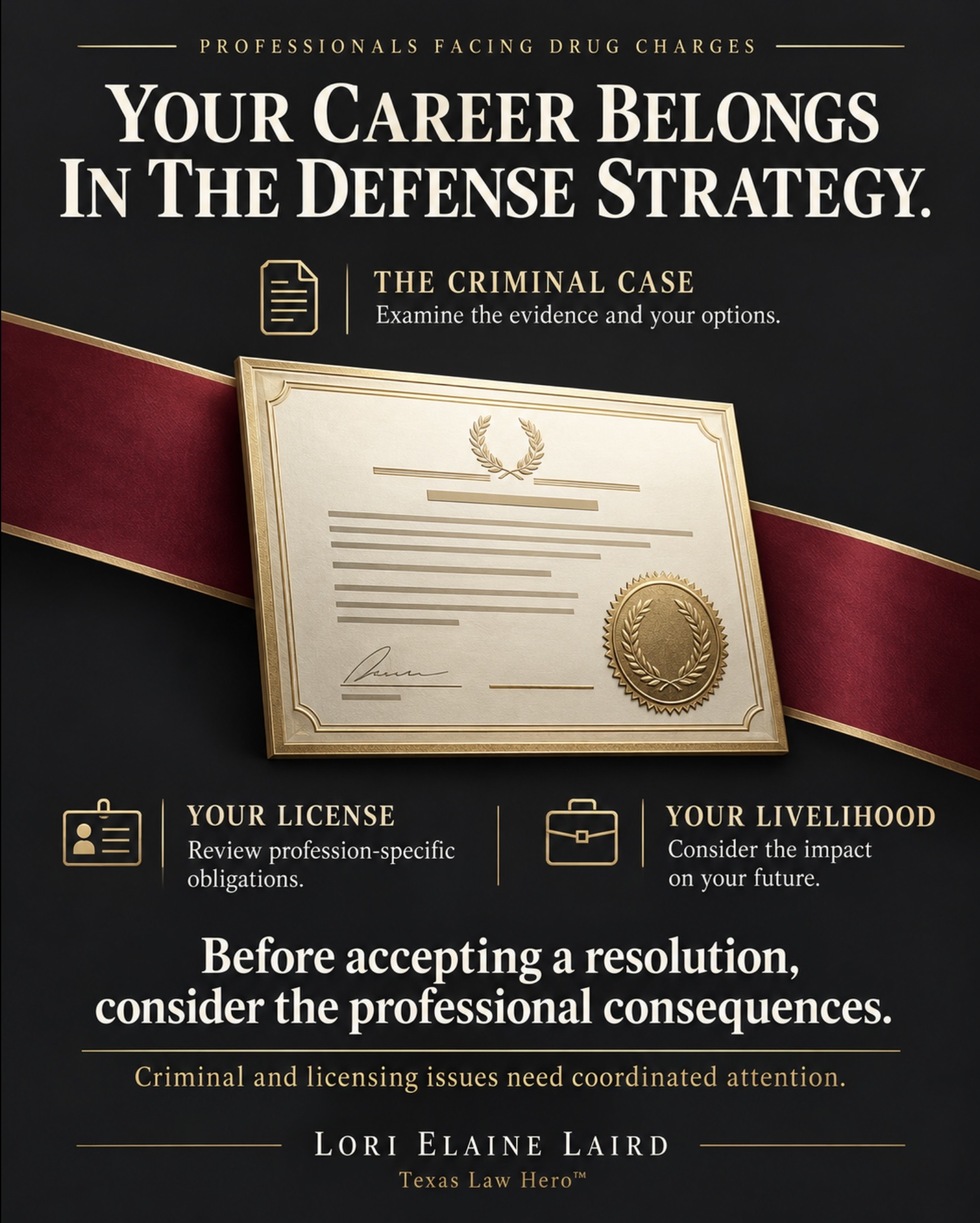
Evaluate the Career Consequences Before Accepting a Resolution
A plea offer may appear attractive because it avoids incarceration or reduces the immediate criminal exposure. For a licensed professional, that is only part of the analysis.
Before deciding, questions may include:
-
Does the proposed disposition trigger a reporting obligation?
-
How does the licensing board treat a conviction, probation, or deferred adjudication?
-
Could the alleged conduct lead to a separate investigation?
-
Are there employment, credentialing, or renewal disclosures to consider?
-
Should licensing counsel review the proposed resolution before it is accepted?
Deferred adjudication should not be assumed to eliminate professional consequences. The rules governing your particular license must be examined.
Lori considers these concerns in evaluating criminal defense options and, when appropriate, coordinates with separate professional licensing counsel.
An Investigative Perspective on Your Criminal Defense
As a former police officer, patrol sergeant, and hostage negotiator, Lori brings practical investigative experience to reviewing the prosecution's case.
Depending on the allegation, that review may include police reports, search warrants, recordings, laboratory results, prescription records, witness accounts, and evidence offered to connect you to the alleged conduct.
Important questions may concern how evidence was obtained, whether records support the accusation, who had access to medications or other substances, and whether witness accounts are consistent.
Your professional standing does not replace the need for a thorough criminal defense. It makes careful preparation and informed decision-making especially important.
Address Reporting and Disclosure Questions Promptly
If you receive a board inquiry, employer request, renewal question, or other demand for information, obtain advice promptly about what is required and when.
Keep copies of relevant notices and bring them to your consultation. Discuss applicable reporting obligations before submitting a substantive explanation or making statements about the alleged conduct.
The goal is to meet your obligations accurately while considering how statements or submissions may affect the criminal case and any related proceeding.
Discuss Your Case With Lori Elaine Laird
If you are a licensed professional facing a drug investigation or criminal charge, contact the Law Office of Lori Elaine Laird to discuss your situation.
Bring information about your professional license, the criminal accusation, upcoming court dates, and any communications from your employer or licensing board.
From her Pasadena office, Lori represents clients in Houston, Galveston, and throughout Harris, Galveston, Brazoria, Liberty, Chambers, and Montgomery counties. Cases elsewhere in Texas are considered individually.
Call 844-FOR-LORI or schedule a confidential consultation.
Lori Elaine Laird | Texas Law Hero™
Your Career Took Years to Build. Your Defense Should Reflect What's at Stake.
You invested time, money, and personal sacrifice in earning your professional credentials. A drug accusation can threaten more than your freedom—it can create uncertainty about your livelihood, reputation, and ability to continue the work you love.
For a licensed professional, decisions about a criminal case require careful consideration of potential consequences beyond the courtroom. A proposed resolution must be evaluated with your professional obligations and long-term goals in mind.
Lori Elaine Laird represents professionals facing criminal drug allegations throughout Greater Houston and Galveston. She provides candid advice, examines the evidence, and considers the broader concerns affecting your career.
A Criminal Case and a Licensing Matter Are Different Proceedings
The criminal court addresses the criminal accusation. A licensing board or regulatory agency may separately evaluate whether the alleged conduct raises concerns under the rules governing your profession.
Reporting duties, disciplinary standards, and potential consequences vary by profession. Depending on the applicable rules, an arrest, charge, disposition, or underlying conduct may require attention—even before the criminal case concludes.
A favorable criminal resolution does not necessarily resolve every licensing concern. Likewise, avoiding jail does not automatically mean your professional credentials are protected.
Identifying these issues early helps you make informed decisions about your defense.
Professionals Who May Face Additional Concerns
Drug allegations can raise professional issues for people in many fields, including:
-
Physicians, nurses, pharmacists, and other healthcare professionals.
-
Dentists and other licensed clinical practitioners.
-
Teachers and education professionals.
-
Accountants, engineers, and other licensed professionals.
-
Individuals applying for a professional license or renewing existing credentials.
The relevant questions depend on your specific license, the accusation, and your professional circumstances. There is no single reporting rule or disciplinary outcome that applies to every profession.
Drug Allegations That Deserve Careful Review
Lori represents clients facing allegations involving:
-
Possession of controlled substances.
-
Marijuana and other cannabis-related offenses.
-
Possession with intent to deliver.
-
Delivery or manufacture of controlled substances.
-
Prescription fraud or forgery.
-
Alleged unlawful possession or diversion of prescription medications.
-
Drug paraphernalia.
For healthcare professionals, allegations involving access to medications, prescribing, dispensing, or workplace conduct may raise additional questions. The criminal evidence and any related professional concerns require individual evaluation.
Evaluate the Career Consequences Before Accepting a Resolution
A plea offer may appear attractive because it avoids incarceration or reduces the immediate criminal exposure. For a licensed professional, that is only part of the analysis.
Before deciding, questions may include:
-
Does the proposed disposition trigger a reporting obligation?
-
How does the licensing board treat a conviction, probation, or deferred adjudication?
-
Could the alleged conduct lead to a separate investigation?
-
Are there employment, credentialing, or renewal disclosures to consider?
-
Should licensing counsel review the proposed resolution before it is accepted?
Deferred adjudication should not be assumed to eliminate professional consequences. The rules governing your particular license must be examined.
Lori considers these concerns in evaluating criminal defense options and, when appropriate, coordinates with separate professional licensing counsel.
An Investigative Perspective on Your Criminal Defense
As a former police officer, patrol sergeant, and hostage negotiator, Lori brings practical investigative experience to reviewing the prosecution's case.
Depending on the allegation, that review may include police reports, search warrants, recordings, laboratory results, prescription records, witness accounts, and evidence offered to connect you to the alleged conduct.
Important questions may concern how evidence was obtained, whether records support the accusation, who had access to medications or other substances, and whether witness accounts are consistent.
Your professional standing does not replace the need for a thorough criminal defense. It makes careful preparation and informed decision-making especially important.
Address Reporting and Disclosure Questions Promptly
If you receive a board inquiry, employer request, renewal question, or other demand for information, obtain advice promptly about what is required and when.
Keep copies of relevant notices and bring them to your consultation. Discuss applicable reporting obligations before submitting a substantive explanation or making statements about the alleged conduct.
The goal is to meet your obligations accurately while considering how statements or submissions may affect the criminal case and any related proceeding.

Discuss Your Case With Lori Elaine Laird
If you are a licensed professional facing a drug investigation or criminal charge, contact the Law Office of Lori Elaine Laird to discuss your situation.
Bring information about your professional license, the criminal accusation, upcoming court dates, and any communications from your employer or licensing board.
From her Pasadena office, Lori represents clients in Houston, Galveston, and throughout Harris, Galveston, Brazoria, Liberty, Chambers, and Montgomery counties. Cases elsewhere in Texas are considered individually.
Call 832-699-1966 to schedule a confidential consultation.
Lori Elaine Laird | Texas Law Hero™