

Experienced Legal Insight. Practical Solutions. A Better Path to Resolution.
Not every legal dispute needs to end in a courtroom.
Litigation can be expensive, time-consuming, emotionally exhausting, and unpredictable. Even when parties believe strongly in their respective positions, proceeding to trial means placing important decisions in the hands of a judge or jury.
Mediation provides an alternative.
At The Law Office of Lori Laird, PLLC, attorney and mediator Lori Laird offers mediation services for parties and attorneys seeking to resolve family law disputes, civil litigation, business disagreements, and other contested legal matters.
Drawing upon her experience as a Texas trial attorney and her training in advanced family law mediation, Lori brings a practical understanding of litigation, negotiation, and the challenges that prevent parties from reaching an agreement.
Whether mediation is court-ordered or voluntarily requested, our goal is to provide a professional, productive environment where parties can evaluate their options, explore potential solutions, and work toward a mutually acceptable resolution.
Sometimes the strongest resolution is the one the parties create themselves.
What Is Mediation?
Mediation is a form of alternative dispute resolution (ADR) in which a neutral third party helps individuals or businesses attempt to resolve a disagreement without a contested trial.
Unlike a judge or arbitrator, a mediator does not decide who wins or loses. Instead, the mediator facilitates communication, identifies areas of agreement, helps clarify disputed issues, and assists the parties in exploring possible settlement options.
The parties retain control over whether to settle and the terms of any agreement they reach.
Mediation can be particularly effective when the participants are willing to evaluate their respective positions, consider practical alternatives, and work toward a resolution that addresses their individual needs.
Although not every mediation results in settlement, the process can help narrow disputed issues and promote a better understanding of the risks and costs associated with continued litigation.
Why Choose Mediation Instead of Trial?
Trial is sometimes necessary. But it is not always the most efficient or effective way to resolve a legal dispute.
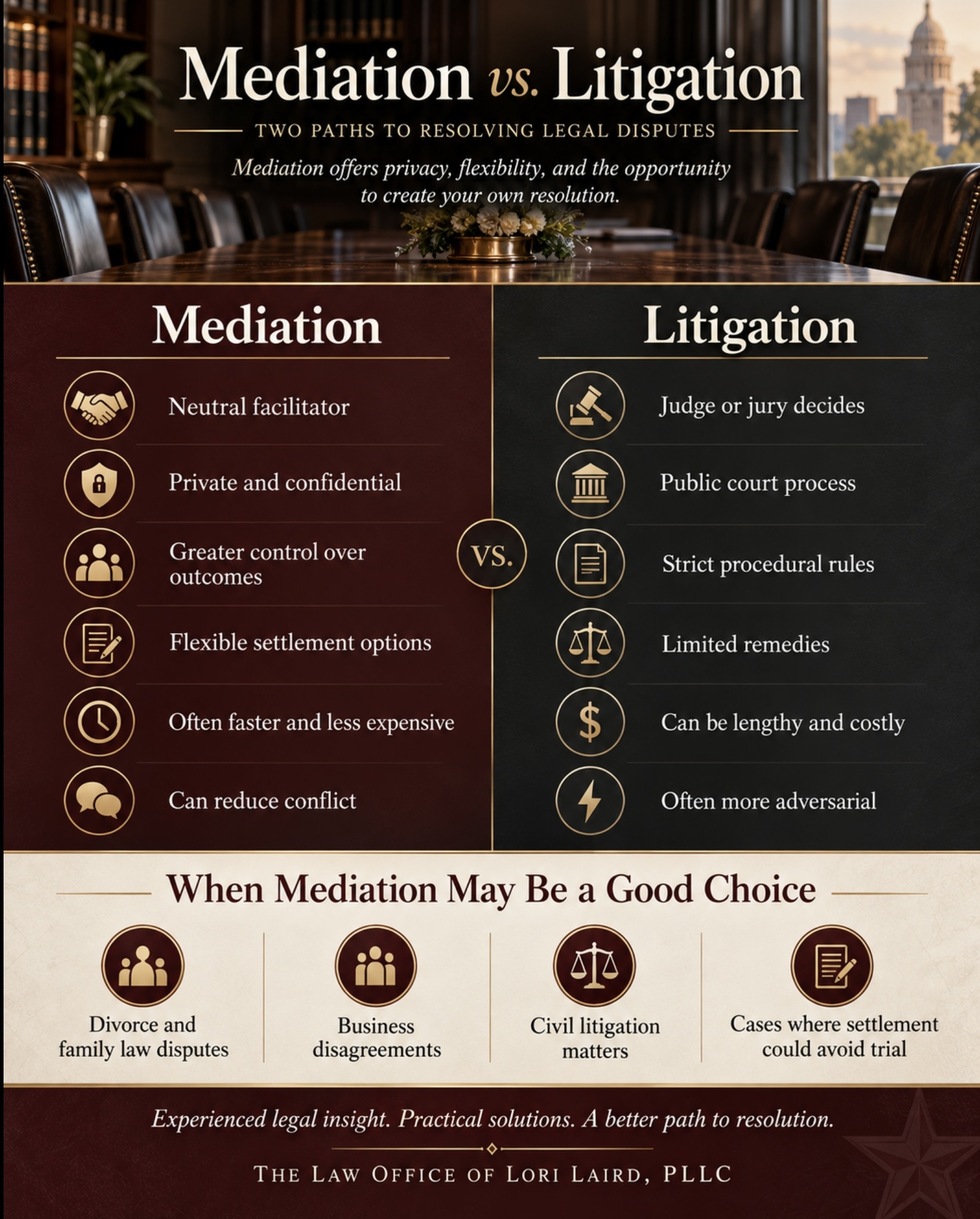
Mediation offers several potential advantages.
Greater Control Over the Outcome
In court, a judge or jury makes decisions based on the evidence and applicable law. The final result may be disappointing to one or both parties.
In mediation, the participants have an opportunity to negotiate the terms of their own resolution rather than simply accept an outcome imposed by the court.
Reduced Litigation Expenses
Preparing for and attending trial can involve substantial attorney's fees, expert witness expenses, discovery costs, and time away from work or family.
When mediation results in a settlement, parties may avoid some of the additional expenses associated with continued litigation.
A More Efficient Resolution
Court dockets, procedural requirements, and scheduling conflicts can delay resolution for months or longer.
Mediation often provides an opportunity to address disputed issues within a scheduled half-day or full-day session.
Privacy and Confidentiality
Texas law generally protects communications made during qualifying mediation proceedings, subject to applicable statutory exceptions.
This confidential setting can encourage candid discussions and meaningful settlement negotiations.
Flexible, Creative Solutions
Courts are limited in the relief they can award. In mediation, parties may be able to develop practical settlement terms tailored to their circumstances, provided those terms are lawful and appropriate.
Reduced Conflict
Mediation may help parties resolve disputes without the additional hostility that can accompany contested litigation.
This can be particularly valuable when the parties must maintain an ongoing relationship, such as parents raising children or businesses with continuing contractual obligations.
Family Law Mediation
Family law disputes are often emotionally charged because the decisions involved affect children, finances, property, and the future of entire families.
Mediation provides an opportunity to address these sensitive matters in a structured environment while exploring solutions that may better fit the family's circumstances.
Lori Laird has experience in family law litigation and advanced family mediation training, providing a strong foundation for understanding the legal and practical issues that arise in family law negotiations.
Family law mediation may address matters including:
● Divorce: Negotiating terms of divorce settlements and resolving disputed issues.
● Property Division: Addressing the division of community property, debts, retirement interests, and other marital assets.
● Child Custody and Conservatorship: Developing parenting arrangements involving decision-making rights and responsibilities.
● Possession and Access: Negotiating parenting time, visitation schedules, holidays, and exchanges.
● Child Support: Exploring appropriate support arrangements consistent with Texas law.
● Spousal Maintenance: Addressing financial support issues when applicable.
● Post-Divorce Modifications: Resolving disputes involving requested changes to existing family court orders.
● Other Family Law Disputes: Assisting parties in exploring negotiated resolutions to contested family law matters.
Family mediation can be particularly beneficial when parents wish to reduce conflict and maintain greater control over decisions affecting their children.
However, mediation may not be appropriate in every situation, particularly when family violence, coercion, or serious power imbalances are present. Those circumstances require careful consideration and appropriate safeguards.
Civil Litigation and Business Mediation
Commercial and civil disputes often involve more than determining who is legally right.
Parties must also consider litigation expenses, business relationships, collectability, financial exposure, and the practical consequences of continuing a lawsuit.
With experience handling contested civil litigation matters, Lori understands the importance of evaluating both the legal merits of a dispute and the practical considerations that influence settlement.
Civil and business mediation may involve:
● Contract disputes
● Business and commercial disagreements
● Real estate and property disputes
● Construction-related litigation
● Breach of fiduciary duty claims
● Business ownership and partnership disputes
● Financial disputes
● Other civil litigation matters appropriate for mediation
Mediation allows parties and their attorneys to explore settlement possibilities, assess litigation risks, and consider resolutions that may not be available through a traditional court judgment.
A successful settlement is not necessarily about one side surrendering. It is about finding a resolution that makes more sense than continuing the fight.
Why Experience as a Trial Attorney Matters in Mediation
Effective mediation requires more than moving settlement offers from one room to another.
A mediator must understand how litigation works, recognize the legal and factual issues driving the dispute, and help participants realistically evaluate the potential consequences of proceeding to trial.
Lori Laird brings her experience as a practicing Texas litigation attorney to the mediation process.
Her background in family law and civil litigation provides insight into the challenges attorneys and clients face when attempting to resolve contested matters.
This experience helps facilitate meaningful discussions about disputed facts, evidentiary questions, litigation risks, financial considerations, and potential settlement options.
As a mediator, Lori serves as a neutral facilitator, not as an advocate or attorney for either party. Her role is to encourage productive communication and assist the participants in reaching an agreement they believe is appropriate.
What Happens During Mediation?
For individuals who have never participated in mediation, the process can seem unfamiliar or intimidating.
Although every mediation is different, the process generally involves several stages.
1. Preparation
Before the scheduled mediation, the parties and their attorneys may provide background information, relevant pleadings, or confidential mediation statements to help identify the disputed issues.
2. Opening the Mediation
The mediator explains the process, discusses confidentiality, and establishes expectations for productive settlement discussions.
3. Identifying the Issues
The parties have an opportunity to communicate their positions and identify the matters that must be resolved.
4. Private Negotiations
In many mediations, the mediator meets separately with each party and their attorney.
These private discussions allow participants to evaluate their positions, consider proposals, and communicate settlement possibilities through the mediator.
5. Exploring Settlement Options
The mediator helps the parties exchange proposals, identify areas of agreement, and work through remaining disagreements.
6. Reaching an Agreement
When the parties reach a settlement, the terms may be reduced to a written agreement.
The legal effect of that agreement depends on the nature of the case and applicable law. In certain Texas family law matters, a properly executed mediated settlement agreement may be binding and not subject to revocation.
If the parties cannot resolve every issue, mediation may still help narrow the matters remaining for litigation.
Half-Day and Full-Day Mediation Sessions
Our office offers both half-day and full-day mediation sessions to accommodate the needs of the parties and the complexity of the dispute.
Half-Day Mediation
A half-day session may be appropriate for disputes involving a limited number of issues, relatively straightforward factual questions, or cases in which the parties have already made meaningful progress toward settlement.
Full-Day Mediation
A full-day session may be more appropriate for complex litigation, contested family law cases involving multiple issues, substantial property disputes, or matters requiring extensive negotiation.
We strive to provide a comfortable and professional mediation environment, with wireless internet access, refreshments, and presentation materials such as whiteboards and easels.
We also make reasonable efforts to accommodate special requests when arrangements are made in advance.
Mediation fees, availability, scheduling requirements, and other logistical details can be discussed when arranging a session.
Frequently Asked Questions About Texas Mediation
Is Mediation Required Before Trial in Texas?
Many Texas courts encourage mediation and may order parties to participate in mediation before trial.
Whether mediation is required depends on the court, the type of case, applicable law, and any relevant court order.
Do I Need an Attorney at Mediation?
Although some mediations involve unrepresented parties, having independent legal counsel can be particularly important when significant property rights, custody matters, or other substantial legal interests are at stake.
The mediator remains neutral and does not provide individual legal representation to either party.
Is Mediation Confidential?
Texas law generally protects mediation communications from disclosure, subject to applicable exceptions. These protections are intended to encourage candid settlement discussions.
What Happens If We Cannot Reach an Agreement?
If mediation does not result in a complete settlement, the case may continue through the litigation process.
The parties may also agree to resolve some issues while leaving others for further negotiation or court determination.
Is a Mediated Settlement Agreement Binding?
The enforceability of a mediated settlement agreement depends on the applicable law and the terms and execution of the agreement.
Certain Texas family law agreements may become binding and irrevocable when specific statutory requirements are satisfied.
Parties should carefully review proposed agreements with their attorneys before signing.
Schedule a Mediation With Lori Laird
Whether you are an attorney seeking a mediator for a pending case or a party interested in exploring an alternative to trial, we welcome inquiries about mediation availability and scheduling.

At The Law Office of Lori Laird, PLLC, our goal is to provide a professional, constructive setting where parties can focus on resolving their disputes rather than prolonging them.
Experienced legal insight. Productive negotiations. Practical solutions.
To inquire about half-day or full-day mediation, contact our office at 832-699-1966 or submit an online mediation scheduling inquiry.
Serving Houston, Pasadena, Galveston, and surrounding Texas communities.