
When a Loved One Passes, You Shouldn't Have to Navigate the Legal Process Alone.
Losing someone you love is difficult enough. The last thing you need during an already emotional time is the added stress of trying to understand probate laws, court filings, creditor claims, and the legal responsibilities involved in settling an estate.
Whether your loved one left a will or passed away without one, administering an estate can involve important legal decisions, strict procedural requirements, and responsibilities that may be unfamiliar to surviving family members.
At The Law Office of Lori Laird, PLLC, we help families, executors, administrators, and heirs throughout Houston, Pasadena, Galveston, and surrounding Texas communities navigate probate and estate administration.
From straightforward probate proceedings to more complicated estates involving substantial property, multiple beneficiaries, or questions of heirship, our firm provides experienced legal guidance to help clients understand their options and move forward.
You focus on your family. We'll help you navigate the legal process.
What Is Probate in Texas?
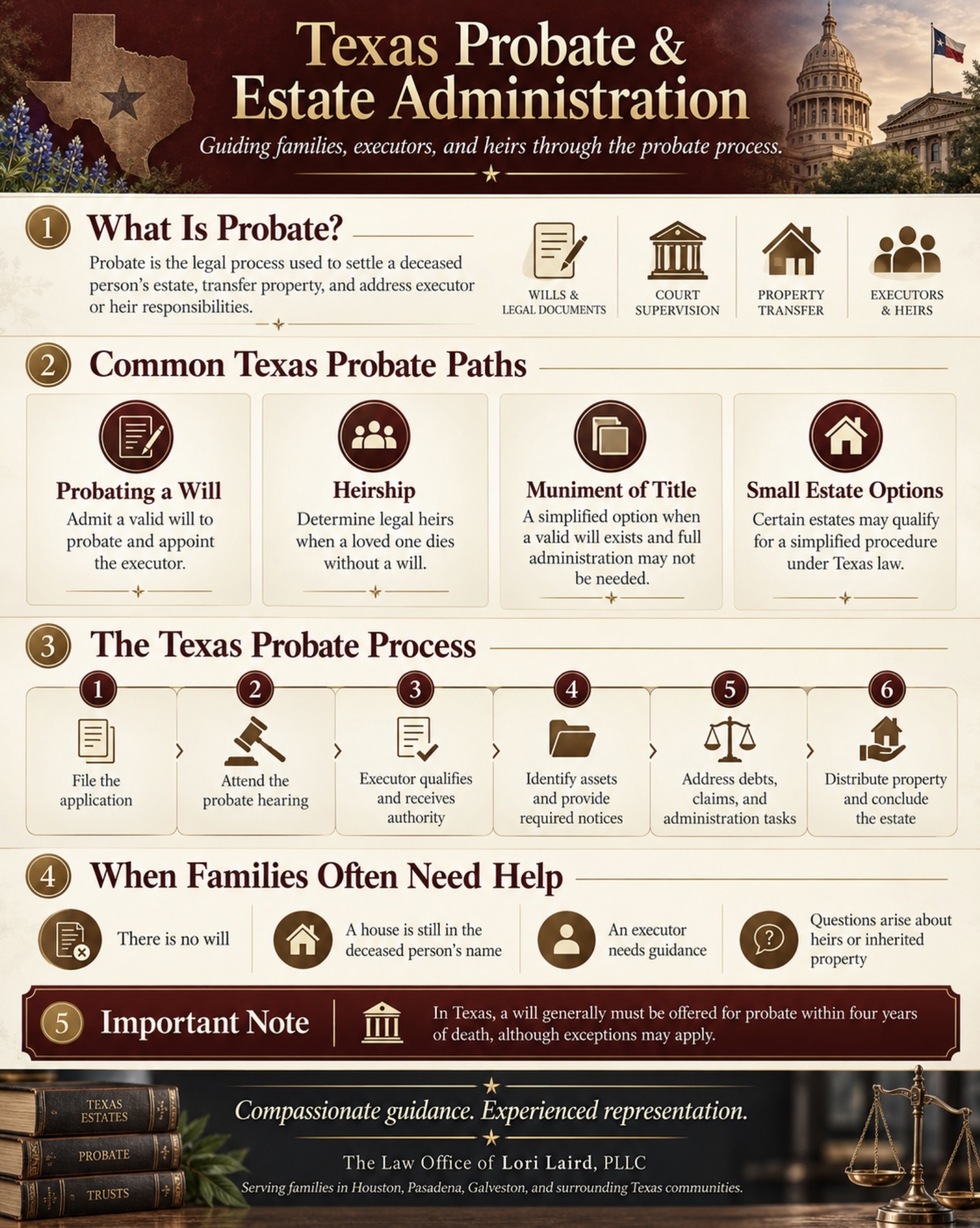
Probate is the legal process used to address a deceased person's estate. Depending on the circumstances, it may involve establishing the validity of a will, identifying the rightful heirs, appointing an executor or administrator, addressing estate debts, and transferring property to the appropriate beneficiaries.
Not every estate requires a full probate administration, and some property may pass directly to surviving owners or designated beneficiaries without probate.
However, when assets remain titled in the deceased person's name, creditors must be addressed, or legal authority is needed to manage estate property, court proceedings may become necessary.
The type of probate procedure required depends on several factors, including whether a valid will exists, the nature and value of the assets, outstanding debts, and the relationships among surviving family members.
Our firm can help determine which Texas probate procedure is appropriate for your circumstances.
Probating a Will in Texas
When someone dies leaving a valid Last Will and Testament, the will may need to be admitted to probate before an executor can obtain the authority necessary to administer the estate.
In a typical probate administration, the process may involve:
1. Filing an application to probate the will in the appropriate Texas court.
2. Providing the notices and citations required by law.
3. Attending a probate hearing to establish the necessary legal requirements.
4. Obtaining an order admitting the will to probate and appointing an executor, when administration is necessary.
5. Qualifying the executor and obtaining Letters Testamentary.
6. Identifying, protecting, and managing estate assets.
7. Addressing required notices, inventories, creditor claims, and other administrative obligations.
8. Distributing estate property in accordance with the will and applicable Texas law.
Although the process may appear straightforward, even uncontested probate proceedings require compliance with specific legal requirements.
We guide clients through these steps and assist executors in fulfilling their responsibilities.
Independent and Dependent Estate Administration
Texas law recognizes different forms of estate administration, each involving varying levels of court supervision.
Independent Administration
Independent administration generally permits an executor or administrator to manage and settle an estate with less ongoing court involvement.
This procedure is often available when the will authorizes independent administration or when the statutory requirements for an agreed independent administration are satisfied.
Independent administration may help reduce expenses, simplify procedures, and allow estate matters to proceed more efficiently.
However, independent executors and administrators remain responsible for complying with their legal duties. Reduced court supervision does not eliminate fiduciary obligations.
Dependent Administration
Dependent administration involves greater court oversight. The estate's personal representative generally must obtain court authorization before taking many significant actions.
While this process may involve additional time and expense, judicial supervision can provide important protections in estates involving disputes, uncertainty, or other complications.
We help clients evaluate the appropriate form of administration and provide guidance throughout the proceedings.
Probate Without a Will: Determination of Heirship
What happens when someone dies without leaving a will?
In Texas, the deceased person's probate property generally passes according to the state's intestacy laws.
However, determining who inherits property is not always as simple as identifying the surviving spouse or children.
Inheritance rights can depend on several factors, including:
● Whether the deceased person was married at the time of death
● Whether the property was separate or community property
● Whether the deceased had children from a prior relationship
● Whether children or other heirs survived the deceased
● Whether particular assets pass outside the probate estate
In some circumstances, a court proceeding known as a determination of heirship may be necessary to legally identify the heirs and their respective inheritance interests.
A determination of heirship may also involve the appointment of an administrator when formal estate administration is necessary.
Our firm assists families in establishing inheritance rights and navigating the legal process when a loved one dies without a valid will.
Probate as a Muniment of Title
Not every estate requires the appointment of an executor or a full estate administration.
Under appropriate circumstances, Texas law permits a will to be admitted to probate as a muniment of title.
This procedure may be available when a valid will exists and the estate has no unpaid debts other than debts secured by liens on real estate, or when there is otherwise no necessity for administration.
When appropriate, muniment of title can provide a more streamlined method of establishing ownership of property passing under a will.
This procedure can be particularly useful when the primary objective is to establish title to real estate or other property without undertaking a traditional estate administration.
However, muniment of title is not appropriate for every estate, and additional obligations or limitations may apply.
We evaluate whether this procedure is available and appropriate for your particular circumstances.
Small Estate Affidavits and Other Probate Alternatives
Some Texas estates may qualify for simplified procedures that avoid the need for a traditional administration.
For example, a Small Estate Affidavit may be available when a person dies without a will and the estate meets specific statutory requirements involving the value and nature of the assets, debts, and heirs.
Other property may pass through beneficiary designations, survivorship arrangements, transfer-on-death deeds, or other mechanisms without traditional probate proceedings.
The availability of these alternatives depends on the specific facts.
Before initiating a full probate administration, we can examine whether a simpler and more cost-effective legal procedure is appropriate.
Helping Executors Understand Their Responsibilities
Being named executor of a loved one's will can feel like an honor. It can also become an overwhelming responsibility.
Executors are responsible for handling estate affairs in accordance with Texas law, the terms of the will, and applicable court orders.
Depending on the nature of the estate, those responsibilities may include:
● Locating and safeguarding estate property
● Identifying financial accounts, real estate, and other assets
● Preparing required inventories or alternative filings
● Providing legally required notices to beneficiaries and creditors
● Evaluating and addressing estate debts and claims
● Managing estate expenses
● Coordinating necessary tax reporting with qualified tax professionals
● Maintaining appropriate estate records
● Distributing property to the appropriate beneficiaries
● Completing the steps necessary to conclude estate administration
An executor's legal responsibilities can be substantial, and mistakes may create personal liability under certain circumstances.
Our firm works with executors and administrators to help them understand their duties, satisfy applicable legal requirements, and protect the estate throughout administration.
What If the Estate Includes a House or Other Real Property?
Real estate is frequently one of the most significant assets in a Texas estate.
When a deceased person owned a home, land, or other real property, questions may arise about legal title, outstanding mortgages, property taxes, homestead rights, and the authority to sell or transfer the property.
The appropriate procedure depends on how the property was owned, whether a valid will exists, whether administration is necessary, and who is entitled to inherit.
In some cases, probate of a will as a muniment of title may provide an appropriate solution. In others, formal administration, a determination of heirship, or another legal procedure may be required.
We help families evaluate their options and address the legal steps necessary to establish ownership or facilitate the proper transfer of inherited real property.
What Happens When Probate Becomes Contested?
Not every estate administration proceeds without disagreement.
Sometimes disputes arise concerning the validity of a will, the identity of heirs, the ownership of property, or the conduct of an executor or administrator.
When these disagreements cannot be resolved, probate litigation may become necessary.
Unlike firms that focus exclusively on routine estate administration, our practice also handles contested probate matters and civil litigation.
We represent clients in disputes involving will contests, undue influence, executor misconduct, fiduciary duties, and contested inheritance rights.
When an estate matter becomes a courtroom dispute, having an attorney experienced in litigation can make an important difference.
Learn more about our Probate & Estate Litigation services.
How Long Does Probate Take in Texas?
One of the first questions families ask is how long the probate process will take.
The answer depends on the type of proceeding and the complexity of the estate.
An uncomplicated probate matter may proceed relatively efficiently, while estates involving disputed property, creditor issues, tax complications, difficult-to-locate heirs, or litigation may require substantially more time.
Although independent administration generally involves less court supervision than dependent administration, the overall timeline still depends on the estate's particular circumstances and the required legal steps.
Our goal is to help clients understand the process, avoid unnecessary complications, and move their matters forward as efficiently as reasonably possible.
Is There a Deadline to Probate a Will in Texas?
Texas law generally requires an application to probate a will to be filed within four years after the person's death.
Certain exceptions may apply, including circumstances in which the applicant was not in default for failing to offer the will for probate within that period.
Other estate-related proceedings and claims may have different deadlines.
Because delays can limit available legal options, it is important to seek legal guidance promptly after a loved one's death.
Compassionate Guidance. Experienced Representation.
The loss of a family member can bring grief, uncertainty, and difficult responsibilities. You should not have to face those challenges without reliable legal guidance.
At The Law Office of Lori Laird, PLLC, we provide personalized representation to families, executors, administrators, heirs, and beneficiaries navigating Texas probate matters.
Whether you need assistance probating a will, establishing heirship, administering an estate, or addressing complications involving inherited property, we are here to help you understand the process and protect your interests.
When your family is facing difficult decisions, experience matters.
Contact our office at 832-699-1966 or submit our online contact form to schedule a probate consultation.
Serving clients throughout Houston, Pasadena, Galveston, and surrounding Texas communities.